Matrix Synchronized Skating Academy
Removal-From-Sport & Return-To-Sport Protocols
Designated Person(s)
In accordance with the requirements set out in Rowan’s Law and its associated regulation,
every sport organization is required to identify a designated person(s) as having specific
responsibilities under the removal-from-sport and return-to sport protocols. The
responsibilities for the designated person(s) may be shared between one or more
individuals. If your sport organization has more than one designated person(s), please
ensure that each designate is clear about who has what responsibility under the
Removal-from-Sport protocol and the Return To-Sport protocol.
Under the Removal-from-Sport protocol for Matrix Synchronized Skating Academy,
the designated person(s) is/are responsible for ensuring that:
• An athlete is immediately removed from further training, practice or competition if the athlete has sustained a concussion or is suspected of having sustained a concussion, regardless of whether or not the concussion was sustained from a sport activity associated with Matrix Synchronized Skating Academy,
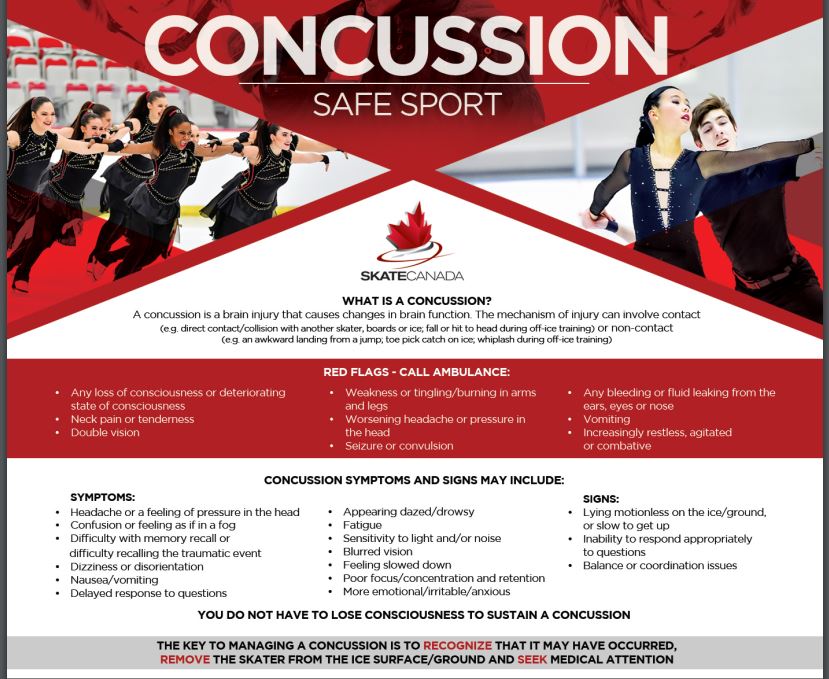
• If in the opinion of the designated person(s), there is an emergency and/or any red flag signs and/or symptoms appear – including those resulting from a suspected concussion, call 911;
• Removal of the athlete from further training, practice or competition; and if the athlete is under 18 years of age, the parent or guardian is informed of the removal;
• The athlete, or the parent or guardian if the athlete is under 18 years of age, is advised that the athlete is required to undergo a medical assessment by a physician or nurse practitioner before the athlete will be permitted to return to training, practice or competition according to the Return-to-Sport protocol for Matrix Synchronized Skating Academy;
• An athlete or, if the athlete is under 18 years of age, the athlete’s parent or guardian
receives the Removal-from-Sport and Return-to-Sport protocols for Matrix Synchronized
Skating Academy as soon as possible after the athlete’s removal; •Once removed, the athlete is not permitted to return to training, practice or competition,
except in accordance with Matrix Synchronized Skating Academy Return-to-Sport protocol;
Under the Return-to-Sport protocol for Matrix Synchronized Skating Academy, the
designated person(s) is/are responsible for ensuring that:
• An athlete who has sustained a concussion or is suspected of having sustained a concussion does not return to training, practice or competition until permitted to do so in accordance with the Matrix Synchronized Skating Academy Return-to-Sport protocol;
• When an athlete has not been diagnosed with a concussion, the athlete is only permitted to return to training, practice or competition if the athlete or, if the athlete is under 18 years of age, the athlete’s parent or guardian provides confirmation to the designated person(s) about the outcome of the athlete’s medical assessment, specifically that the athlete:
• has undergone a medical assessment by the physician or nurse practitioner and has not been diagnosed as having a concussion, and
• has been medically cleared to return to training, practice or competition by a physician or nurse practitioner;
• When an athlete is diagnosed by a physician or nurse practitioner as having a concussion, the athlete is not permitted to move on to unrestricted training, practice or competition unless the athlete or, if the athlete is under 18 years of age, the athlete’s parent or guardian provides a confirmation of medical clearance by the physician or nurse practitioner to the designated person(s);
• An athlete is not permitted to return to training, practice or competition through Matrix Synchronized Skating Academy graduated Return-to-Sport steps unless the athlete or, if the athlete is under 18 years of age, the athlete’s parent or guardian has shared the medical advice or recommendations they received, if any, with the designated person(s);
• When an athlete is diagnosed by a physician or nurse practitioner as having a concussion, the athlete or, if the athlete is under 18 years of age, the athlete’s parent/guardian has been informed of the importance of disclosing the diagnosis to any other sport organization with which the athlete is registered or school that the athlete attends. The regulation states that a designated person(s) may rely on the information received from an athlete or, if the athlete is under 18 years of age, from the athlete’s parent or guardian in carrying out their responsibilities under Matrix Synchronized Skating Academy Return-to-Sport protocol.
|
The following individual(s) is/are recognized by Matrix Synchronized Skating Academy as the “designated person(s)” with respect to Removal-from-Sport and Return-to-Sport protocols for Matrix Synchronized Skating Academy: |
| Name of Designated person(s): | Katie McGarrigle |
| Date: | March 30th, 2026 |
| Term of designation: | 2026/2027 Season |
Removal-from-Sport Protocol
The following outlines a process for immediate removal of an athlete who is suspected of
having sustained a concussion.
1.Remove the Athlete
Designated person(s) to immediately remove the athlete from further training, practice or competition if the athlete has sustained a concussion or is suspected of having sustained a concussion regardless of whether the concussion or suspected concussion was sustained from an activity associated with Matrix Synchronized Skating Academy.
2.Call 9-1-1 if Emergency
Designated person(s) to call 9-1-1 if in their opinion, doing so is necessary (e.g., if there is an emergency and any red flag signs and/or symptoms appear).
3.Inform
If the athlete is under 18 years of age, Designated person(s) to inform the athlete’s parent or guardian about the removal from further training, practice or competition. Designated person(s) to advise the athlete, or the parent or guardian if the athlete is under 18 years of age, that the athlete is required to undergo a medical assessment by a physician or nurse practitioner before the athlete will be permitted to return to training, practice or competition. A medical assessment determines whether the athlete has a concussion. An athlete will not be permitted to return to training, practice or competition until they receive medical clearance by
a physician or nurse practitioner to do so.
4. Give Protocols
Designated person(s) to provide the athlete or, if the athlete is under 18 years of age, the athlete’s parent or guardian with Matrix Synchronized Skating Academy Removal-from-Sport and Return-to-Sport protocols as soon as possible after the athlete has been removed from further training, practice or competition.
5. Record the Incident
Make and keep a record of incidents where an athlete is removed from further training,
practice or competition because they are suspected of having sustained a concussion
regardless of whether the athlete is later diagnosed with a concussion.
| The sport organization must limit the collection, use, and disclosure of personal information to that which is reasonably necessary for the purpose of carrying out the sport organization’s protocols, and to limit access to such personal information to only those individuals who require it for the purpose of fulfilling their duties or obligations under the Act. Personal information collected under this protocol shall be retained, disclosed and disposed of in a secure manner and in accordance with the sport organization’s personal information retention policy. The sport organization shall create a retention policy for personal information. |
6. Returning to Training, Practice or Competition
Once removed, the athlete is not permitted to return to training, practice or competition,
except in accordance with Matrix Synchronized Skating Academy Return-to-play protocol.
Return-to-Sport protocol.
The following outlines a return-to-sport process for an athlete who has been removed from
training, practice or competition due to a suspected or diagnosed concussion, regardless of
whether or not the concussion was sustained or is suspected of having been sustained
during a sport activity associated with Matrix Synchronized Skating Academy.
1. Receive Confirmation
Ensure that an athlete who has sustained a concussion or is suspected of having sustained a concussion does not return to training, practice or competition until the athlete or, if the athlete is under 18 years of age, the athlete’s parent or guardian provides confirmation to the designated person(s) that the athlete:
a) Has undergone a medical assessment by a physician or nurse practitioner and has not been diagnosed as having a concussion, and
b) Has been medically cleared to return to training, practice or competition by the physician or nurse practitioner.
2.If Diagnosed with Having a Concussion
If an athlete has been diagnosed by a physician or nurse practitioner as having a concussion
the athlete must proceed through the graduated return-to-sport steps.
| The Return-to-School Plan (Learning and Physical Activity) Students in elementary and secondary school with a diagnosed concussion must follow their school board’s return-to-school plan, which supports a student’s gradual return to learning and return to physical activity. Contact the school for more information. |
3. Graduated Return-to-Sport Steps
It is important to note that typical recovery times vary from person to person, and that some
individuals may require more time to progress through the graduated return-to-sport steps.
The graduated return-to-sport steps may include the following activities. It is typically
recommended that an athlete with concussion rest for 24 to 48 hours before beginning step 1.
| Activities | Goal of Step | Duration | |
| Step 1: Symptom-limiting activities |
Daily activities that don’t make symptoms worse, such as moving around the home and simple chores |
Gradual reintroduction of daily school, and work activities |
At least 24 hours |
| Step 2: Light aerobic activity |
Light activities such as walking or stationary bicycle at slow to medium pace for 10–15 minutes |
Increase heart rate | At least 24 hours |
| Step 3: Sport-specific exercise |
Individual physical activity such as running or skating No contact or head impact activities |
Add movement | At least 24 hours |
| Step 4: Non-contact training, practice drills |
Harder training drills Add resistance training (if appropriate) |
Exercise, coordination and increased thinking |
At least 24 hours |
| Step 5: Unrestricted training and practice |
Unrestricted training and practice — with contact where applicable |
Restore confidence and assess functional skills |
At least 24 hours Obtain clearance from physician or nurse practitioner before unrestricted training, practice or competition |
| Step 6: Return-to-Sport |
Unrestricted competition |
An athlete is typically ready to progress to the next step when they can do the activities at their current step without new or worsening symptoms. If at any step symptoms get worse, they should stop and return to the previous step before trying again. If symptoms do not improve or if the symptoms continue to worsen, the athlete should return to the physician or nurse practitioner.
4. Share Medical Advice
An athlete, or the athlete’s parent or guardian must share the medical advice or recommendations they receive with the designated person(s) before being permitted to return to training, practice or competition through the graduated return-to-sport steps, if any.
5. Disclosing Diagnosis
The designated person(s) must inform the athlete or, if the athlete is under 18 years of age,
the athlete’s parent or guardian of the importance of disclosing the diagnosis to any other
sport organization with which the athlete is registered or school that the athlete attends.
6. Medical Clearance
The athlete, or the athlete’s parent or guardian must provide the designated person(s) a
confirmation of medical clearance by a physician or nurse practitioner before the athlete is
permitted to move on to unrestricted training, practice or competition.
7. Record Progression
The sport organization must make and keep a record of the athlete’s progression through
the graduated return-to-sport steps until the athlete, or the athlete’s parent or guardian, has
provided a confirmation of medical clearance by a physician or nurse practitioner to the
designated person(s).
| The sport organization must limit the collection, use, and disclosure of personal information to that which is reasonably necessary for the purpose of carrying out the sport organization’s protocols, and to limit access to such personal information to only those individuals who require it for the purpose of fulfilling their duties or obligations under the Act. Personal information collected under this protocol shall be retained, disclosed and disposed of in a secure manner and in accordance with the sport organization’s personal information retention policy. The sport organization shall create a retention policy for personal information. |